
Case Study · Haven Energy · 2026
Customer Proposal
At a glance
The problem Utility programs, deposit terms and system sizing all change the numbers. A generic proposal template couldn't hold that without overwhelming or oversimplifying.
- configurable template covering multiple utility-program variants
- 1
- breakpoints, responsive from the start
- 3
- program proposals live on Haven's website: ConnectedSolutions and SGIP
- 2
Product Designer · Live
The moment a homeowner decides whether a home battery is worth it — a customer-facing proposal designed to make that decision legible, program by program.
Problem
Battery proposals live at the intersection of a real financial decision and a genuinely confusing set of utility programs — deposit terms, state-specific incentive programs like SGIP and ConnectedSolutions, and system sizing all change the numbers a customer is looking at. A generic proposal template couldn't hold that variability without either overwhelming the customer or oversimplifying the offer.
The plan is battery-only. Haven had paused offering solar, but homeowners who already have solar are still considered, based on eligibility.
Where it started
The proposal I inherited was a document, laid out again for every combination of offer. Headed “Battery storage services and installation agreement”, it had a separate layout for each mix of community (EC or Non-EC), payment (monthly or prepaid) and system size (one Tesla Powerwall 3, or one with an expansion unit): eight versions of the first page alone. A first web version carried the same cards onto the page, from price and payment schedule to what’s included, the Haven difference and next steps, and it was still drawn once per combination.
The inherited proposal, one layout per combination


Opportunity
Rather than one static proposal, the work became a configurable proposal that adapts per utility program (PG&E, ConnectedSolutions, and others), so each customer sees the numbers and terms that actually apply to them.
Exploration
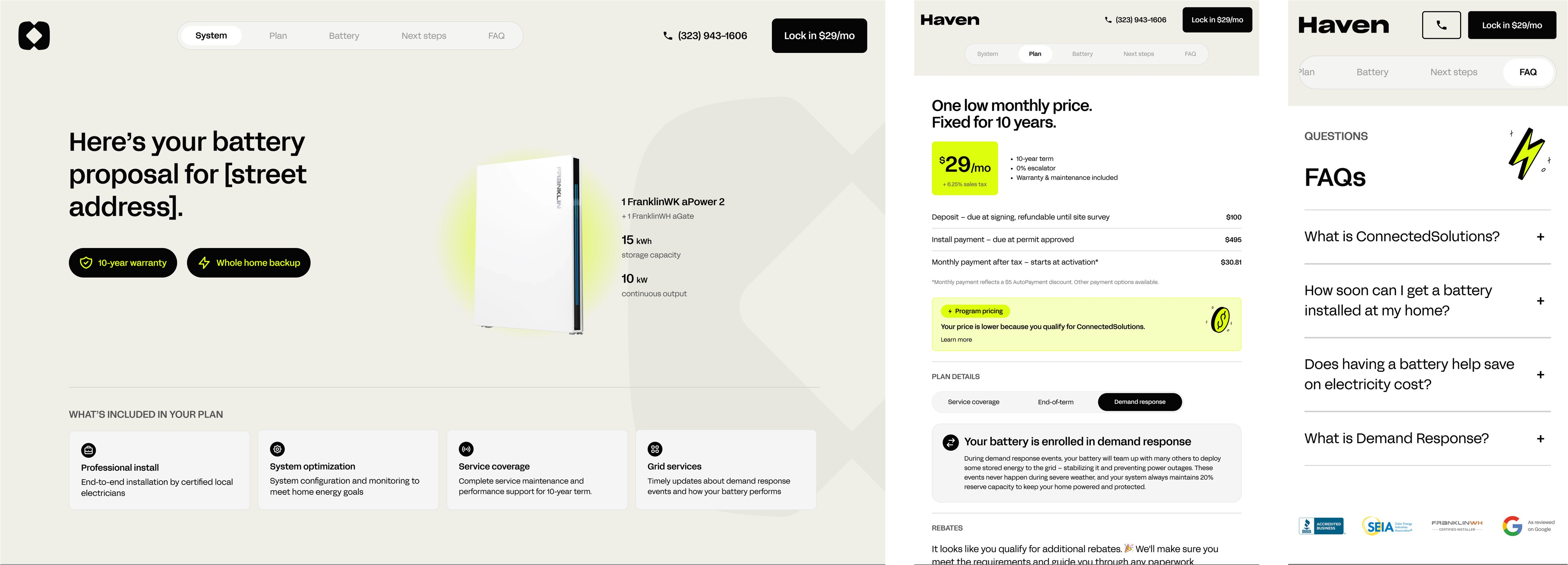
The proposal was built responsively across 402/768/1440px from the start, since this is a flow customers as often complete on a phone standing in their driveway as at a desktop.
The first screen at 1440, 768 and 402
Solution
The proposal surfaces pricing, discounts, a project timeline, testimonials, and an FAQ in a layout that adapts per program — a PG&E customer and a ConnectedSolutions customer see the same trustworthy structure with the numbers and incentive language that actually apply to them.
Program variants
The pricing section carries the variation. A ConnectedSolutions customer sees $29 a month, with a note that the price is lower because they qualify for the program. SGIP and BackupBattery+ customers see a no-cost system, and BackupBattery+ adds a $150 annual participation payment for five years. California EC and Non-EC customers see $64 and $94 a month. Learn more opens a plain-language explanation of the program behind the price.
The Haven plan
One low
monthly price.
Fixed for 10 years.
A no-cost
battery system.
Yours for 10 years.
$29/mo
+ 6.25% sales tax
- 10-year term
- 0% escalator
- Warranty & maintenance included
- Deposit – due at signing, refundable until site survey
- $100
- Install payment – due at permit approved
- $495
- Monthly payment after tax – starts at activation*Monthly payment – starts at activation*
- $30.81$64$94
*Monthly payment reflects a $5 AutoPayment discount. Other payment options available.
Program pricing
Your price is lower because you qualify for ConnectedSolutions.
Your battery system is no-cost through SGIP.
Your battery system is no-cost through the BackupBattery+ Program.
You also get $150 every year, guaranteed for 5 years.
Annual participation payment for being a part of the BackupBattery+ Program
Plan details
Service coverageEnd-of-termDemand response
We handle maintenance & system performance
Haven installs, owns, monitors, and maintains the system for your 10-year term. If there’s an issue, we handle it. You’ll never pay for service calls during your term.
Rebates
It looks like you qualify for additional rebates. 🎉 We’ll make sure you meet the requirements and guide you through any paperwork.
Limited-time $5,000 rebate
You qualify for an additional $5,000 rebate through ConnectedSolutions. We’ll help you apply once your system is installed. Offer ends 9/30/26. Learn more
Program pricing
About ConnectedSolutions Battery Program
ConnectedSolutions is a grid services program run by National Grid, Eversource, and Cape Light. The program incentivizes homeowners to install batteries which help the grid when demand for electricity is very high.
How it works: When demand spikes, your battery will team up with many others to deploy some stored energy to the grid – stabilizing it and preventing power outages.
These events never happen during severe weather, and your system always maintains reserve capacity to keep your home powered and protected.
About Self-Generation Incentive Program (SGIP)
SGIP is a state program funded by the California Public Utility Commission to provide subsidized battery systems for qualifying homeowners.
SGIP rebates vary based on a variety of factors such as income, utility and wildfire risk. You’re currently eligible for the SGIP Residential Solar and Storage Equity rebate, which offers qualifying homeowners completely no-cost battery systems.
Why is the state funding SGIP? As the demand for electricity continues to rise, it’s cheaper and faster to invest in lots of distributed battery systems than to build large power plants. Batteries keep costs down, use clean energy, and respond quickly to spikes at the local level.
About the BackupBattery+ Program
BackupBattery+ is a National Grid program that provides qualifying Fall River residents with a home battery at no cost, plus an annual participation payment of $150, guaranteed for 5 years.
Based on your address, National Grid utility rate plan, and home qualifications, you’re eligible to participate in this program.
Service coverage: Haven installs, owns, and maintains this battery for your 10-year service agreement.
Grid services: You’ll be reimbursed for any energy discharged during demand response events on your electric bill.
Backup power: The system will always maintain reserve capacity to power your home in an outage (typically 4-7 hours).
Why is National Grid funding this program? It’s cheaper and faster to invest in lots of distributed battery systems than to build large power plants. As the demand for electricity continues to grow, programs like BackupBattery+ help lower costs for homeowners while also stabilizing the grid.
Shared sections
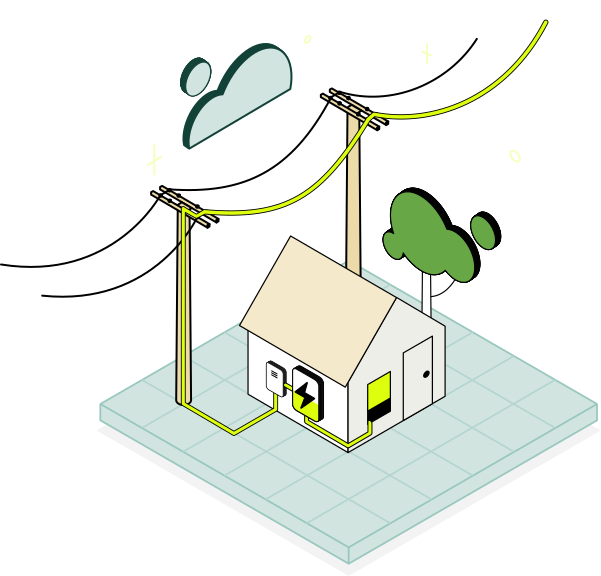
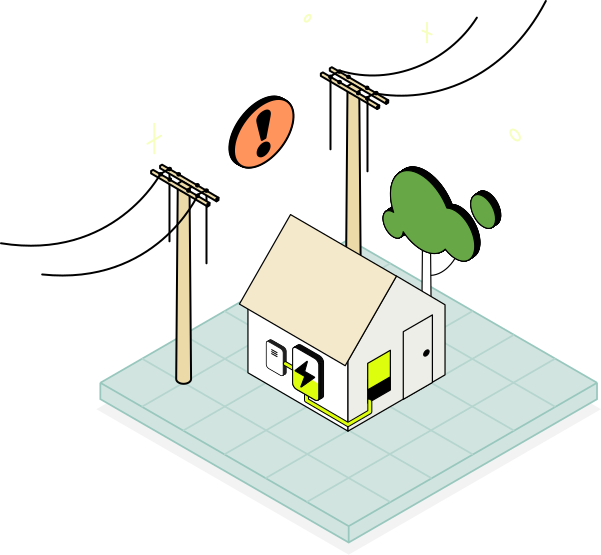
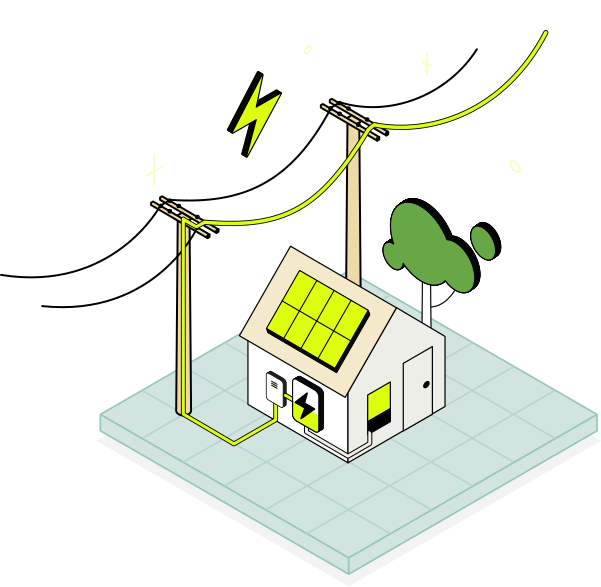
Beyond the pricing, the section that matters most explains how the battery behaves, and that the home always comes first. Every variant shares it, along with a five-step project timeline, customer reviews and an FAQ whose first question follows the program.
Battery
How your battery works
Your battery adapts to every situation, but your home always comes first.Three situations, one consistent promise: your home always comes first.
Running in the background
Your battery charges and stores energy in the background, so it’s ready when you need it. Monitor your system anytime from the app.
Your home stays powered
If there’s an outage, your battery automatically switches to backup mode and starts powering your home. Depending on your usage, a fully charged system can keep essentials running for 1–2 days.
Good for the neighborhood
When demand for electricity is very high, your battery will pitch in and deploy a small amount of stored energy to help stabilize the grid and prevent power outages nearby.
Always keeps a minimum 20% reserve capacity for your home.Always keeps a minimum 20% reserve set aside for your home.
Your home comes first. Your stored energy never dispatches to the grid in an outage.Your stored energy never dispatches to the grid in an outage. It stays home.
Severe weather? Your battery will not participate in a demand response event.Never during severe weather and your 20% home reserve is always protected.
Outcomes
- The ConnectedSolutions and SGIP proposals shipped and are live on havenenergy.com, in front of real customers. Each one sits at the end of the quote flow, so it's only reachable by requesting a quote
- Proposal supports multiple utility-program variants (PG&E, ConnectedSolutions, and others) from one configurable template rather than one-off pages per program
- Built responsive from the start across three breakpoints, matching how customers actually complete the flow